Tech Stack
This Homepage is an application for Humans and Agents.
We author only readable Markdown sources. A local compiler turns those into typed artifacts for a React Router application, while Cloudflare delivers the result.
One source for one application and multiple representations.
Internal and external Agents are provided with the content and custom instructions for every page.
Markdown is the source
All content lives as Markdown files in a filesystem.
All content lives as Markdown files in a filesystem.
All content lives as Markdown files in a local filesystem.

Markdown (with Frontmatter) is authored in and sanitized as for external systems. provides Agents with custom directions.
The content is portable and readable for both Humans and Agents.
One source, multiple uses
The source is converted for various audiences.
The source is converted for various audiences.
The source is converted for various audiences.
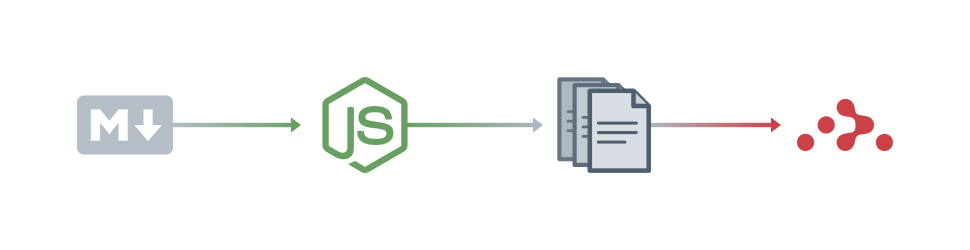
The generator validates and reshapes authored source into runtime data, public source views, Agent-readable Prompts, and the registries the Homepage uses to assemble itself.
Once assembled, React Router handles the presentation.
A compiler does the work
A local compiler generates the distributions.
A local compiler generates the distributions.
A local compiler generates the distributions.

A Node.js Backend reads authored content and App distributions, validates frontmatter and Markdown, resolves Prompt templates, and emits importable TypeScript artifacts for the Frontend.
It turns authored structure into the registries the runtime needs: routes, navigation, and the content.
With local generation, the deployed runtime is simple.
React is the interface
React renders the Homepage from generated data.
React renders the Homepage from generated data.
React renders the Homepage from the generated data.

The same runtime can present Pages, Posts, Presentations, Media, Preferences, and integrated Apps through shared UI primitives and route modules.
React Router turnsthe pages into an application.

React Router supplies the application shell and route model. The Homepage uses ordinary path URLs, nested presentation routes, server-backed behavior, and an SSR-capable runtime.
Vite is the driving force
The build layer turns the data into an application.
The build layer turns the data into an application.
The build layer turns the data into an application.

Generated data and frontend code become the application. Vite connects local development, generated content, and the React Router build.
Changes are visible immediately on localhost.

TypeScript makes the generated contract visible to the Frontend. Authored Markdown remains pleasant to edit while the runtime receives structured, validated modules.
Cloudflare delivers the app
The finished application runs close to its audience.
The finished application runs close to its audience.
The finished application runs close to its audience.

The production Frontend runs as a Cloudflare Worker with its client assets delivered alongside it. Cloudflare R2 and CDN delivery extend the same model to managed media, including adaptive HLS video generated locally.
I love Cloudflare for it's simple effectivenss.
The deployment target is part of the architecture: local generation produces the artifacts that the deployed runtime serves.
Customizable agent interface
The Homepage explains itself to agents.
The Homepage explains itself to agents.
The Homepage explains itself to agents.

A generated combines a reusable template with its related . It gives an Agent the metadata and partly customized instructions in a predictable format.
This makes the Homepage inspectable and teachable.